
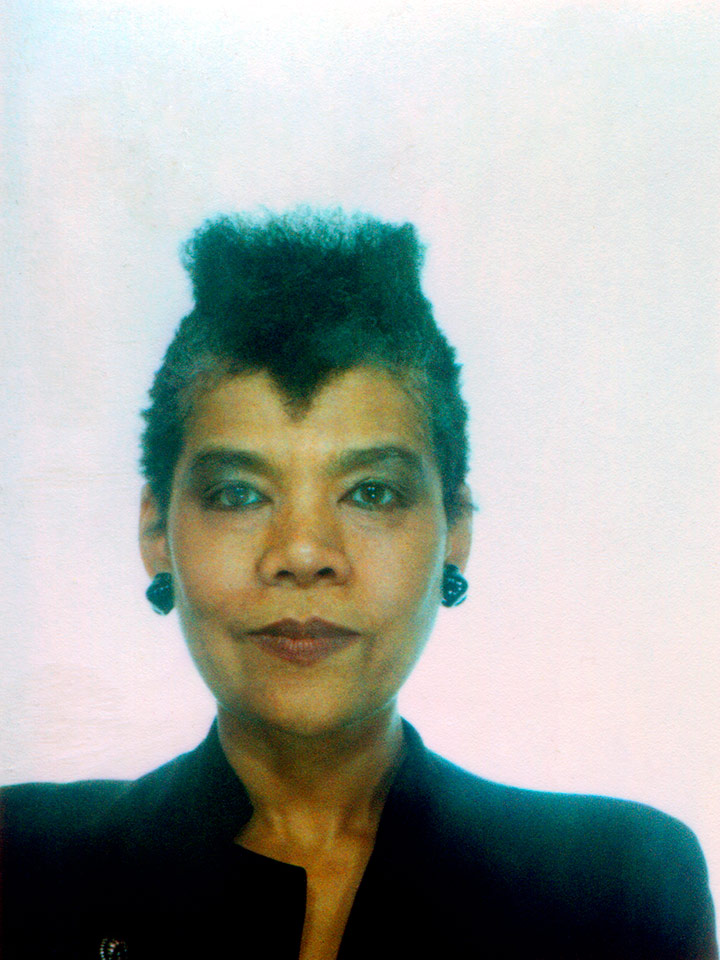
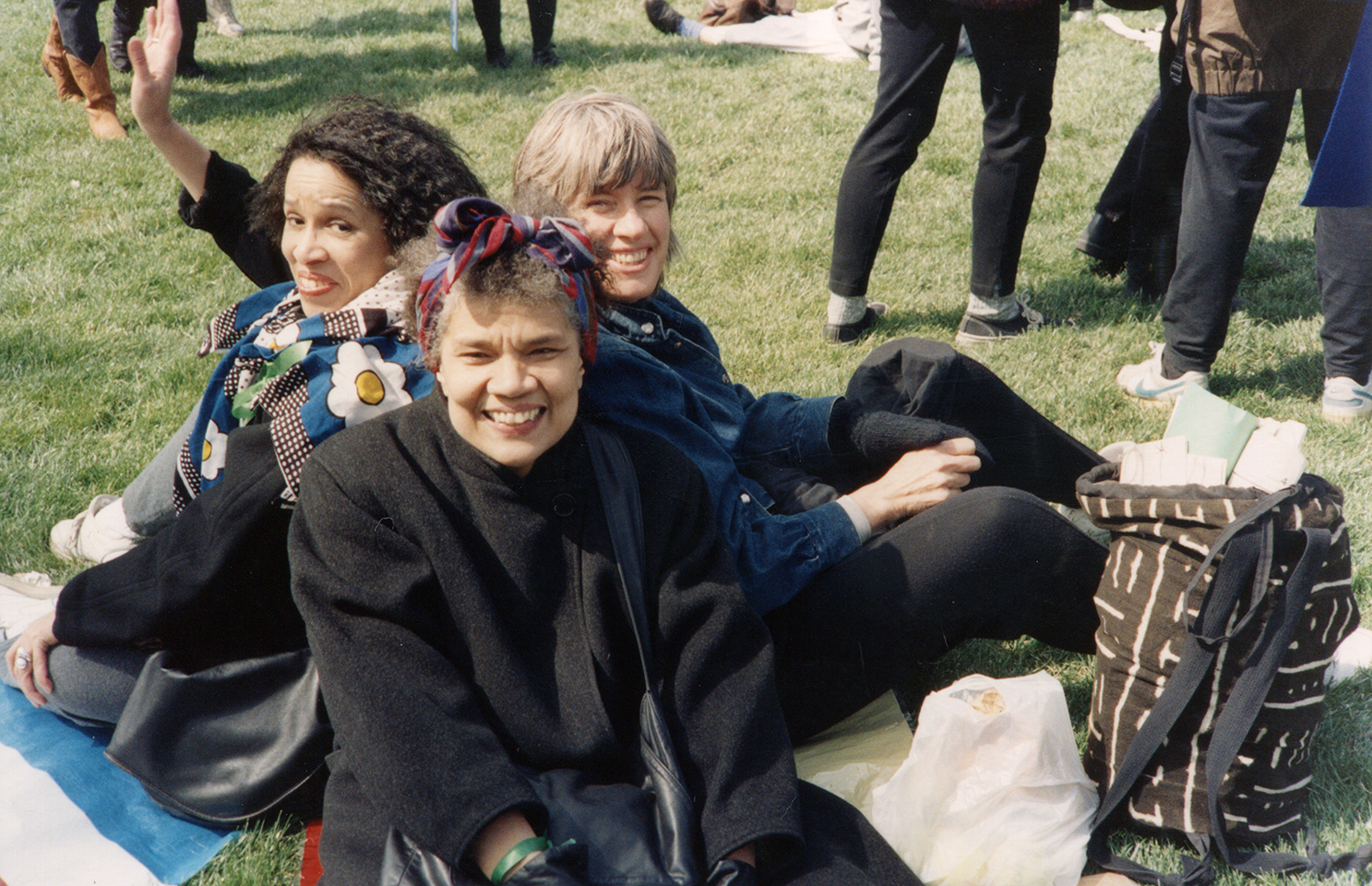
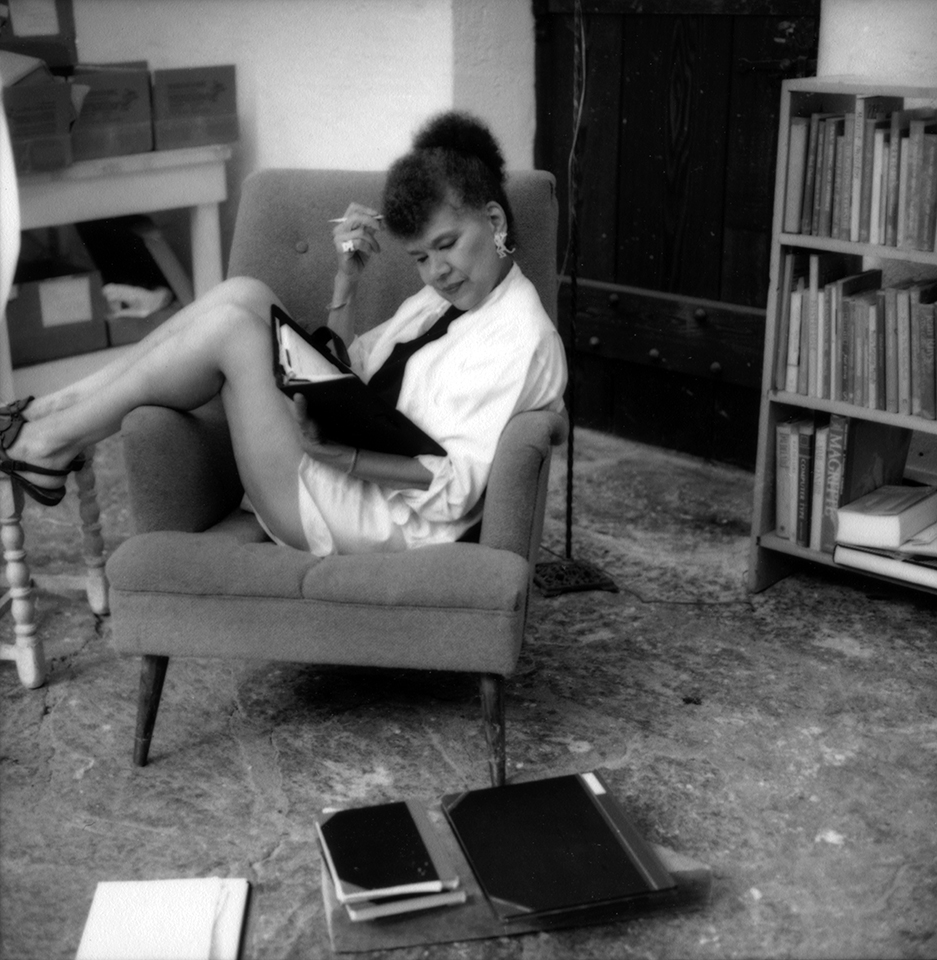
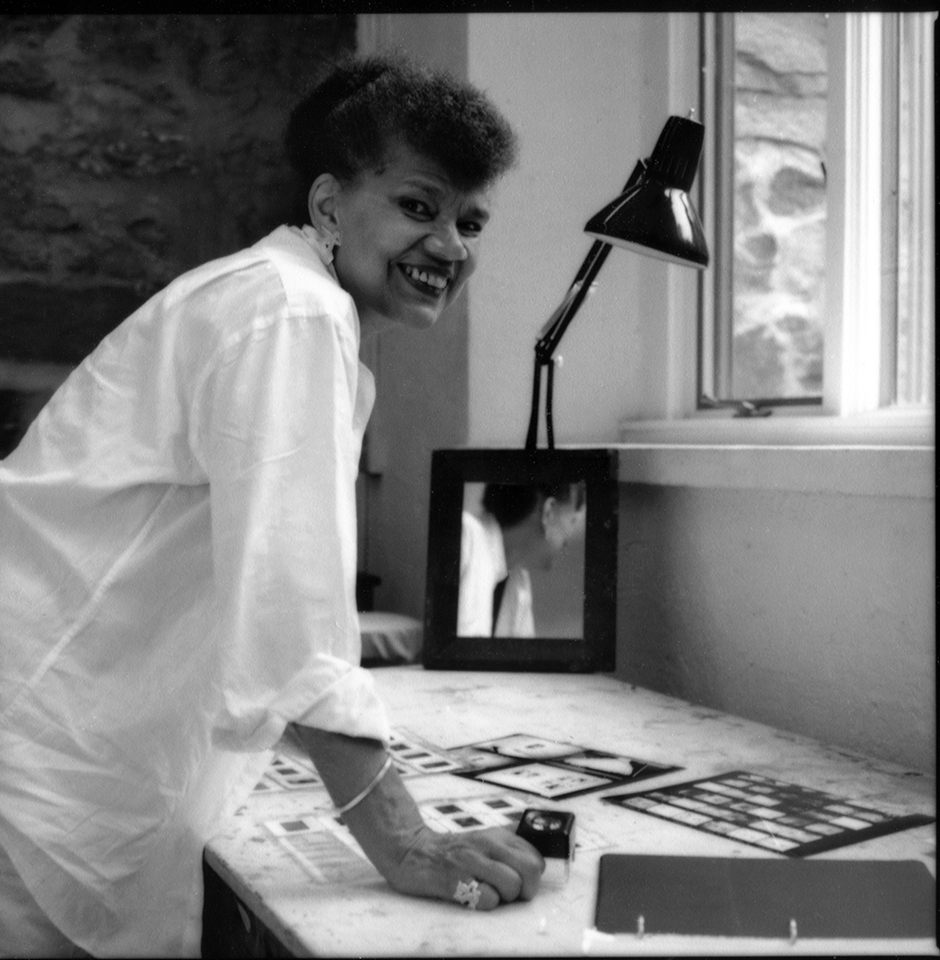
1930s
1934
Lorraine Eleanor O’Grady is born in Boston on September 21 to Jamaican immigrants Lena and Edwin O’Grady. Their daughter Devonia Evangeline, O’Grady’s older sister, is eleven. Lena had emigrated to New York from Old Harbour in 1917 before moving to Boston, where, at a cricket match, she met Edwin, who had emigrated from Kingston in 1919, after returning from service with the British West Indies Regiment in World War I. Both well educated and middle class in Jamaica, they were placed in the working class on arriving in the United States.
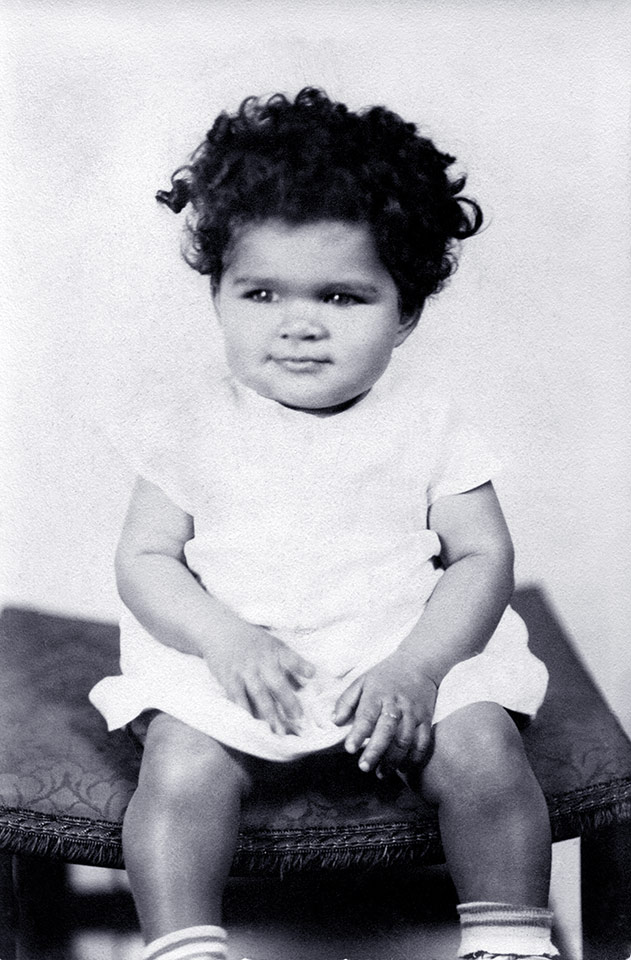
Lorraine O’Grady, studio portrait for her first birthday.
1940s
1942
At eight years old, in the fourth grade, O’Grady writes a novel. A classmate objects to the way she has been portrayed. There is a fight, and the classmate’s face gets badly scratched. O’Grady lands in juvenile court, where the case is dismissed. O’Grady’s mother, Lena, says, “If I ever catch you writing another word . . . ” It will be twenty years before O’Grady attempts a second novel.
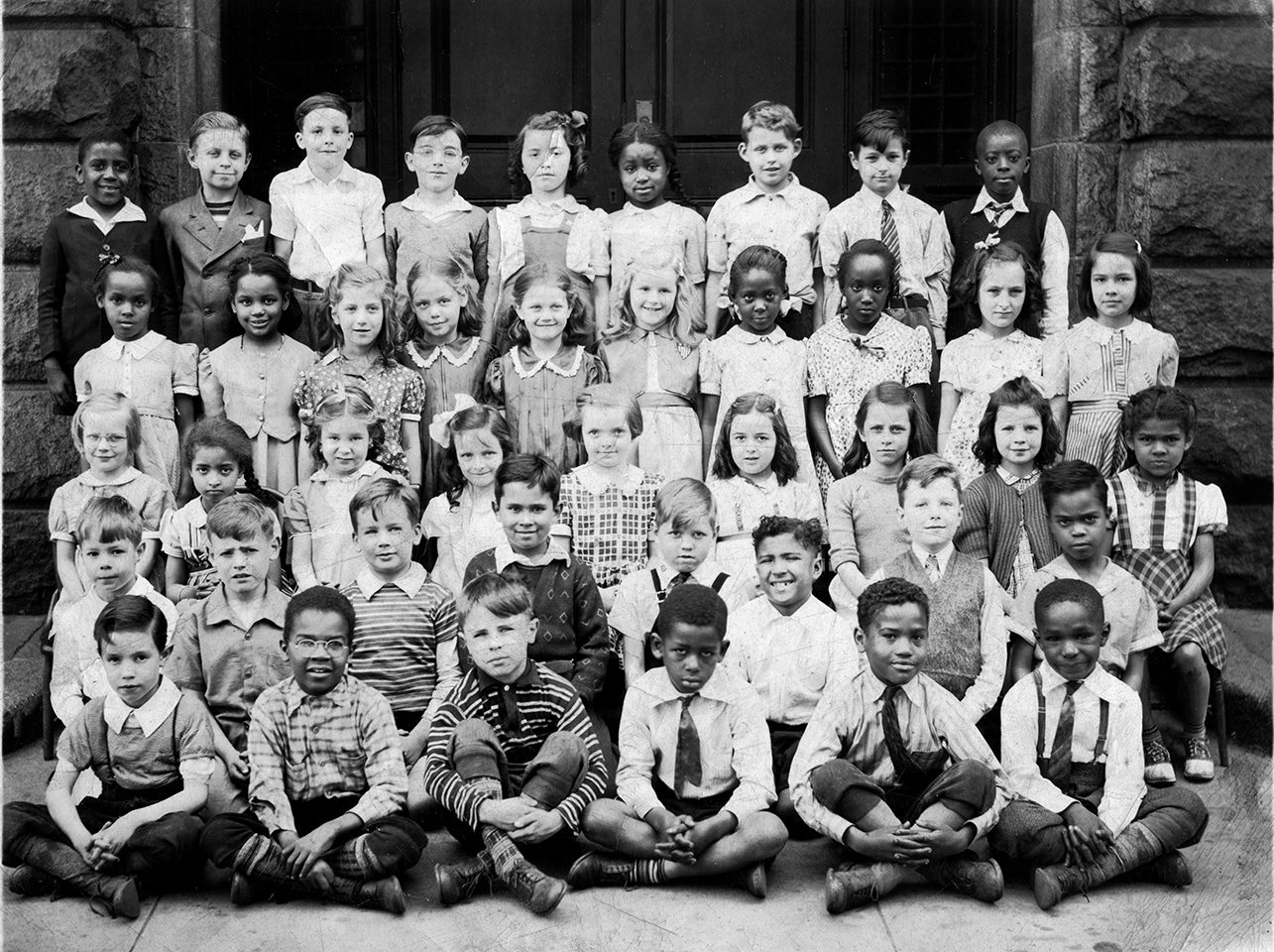
Lorraine O’Grady school picture, St. Botolph Street, Boston, MA, 1941. O’Grady is on the middle row, far right.
1945
O’Grady enters Girls’ Latin School, the six-year public college-preparatory school from which her sister Devonia graduated five years earlier.
1947
O’Grady thrives at Girls’ Latin, despite being adversely compared by many teachers to her sister (“Devonia was a lady”). Without consulting her family, O’Grady disaffiliates from St. Cyprian’s Episcopal, the family parish, and begins attending mass regularly at St. John’s of Roxbury Crossing, a small High Episcopal church close to her new school that is staffed by Harvard Divinity School faculty.
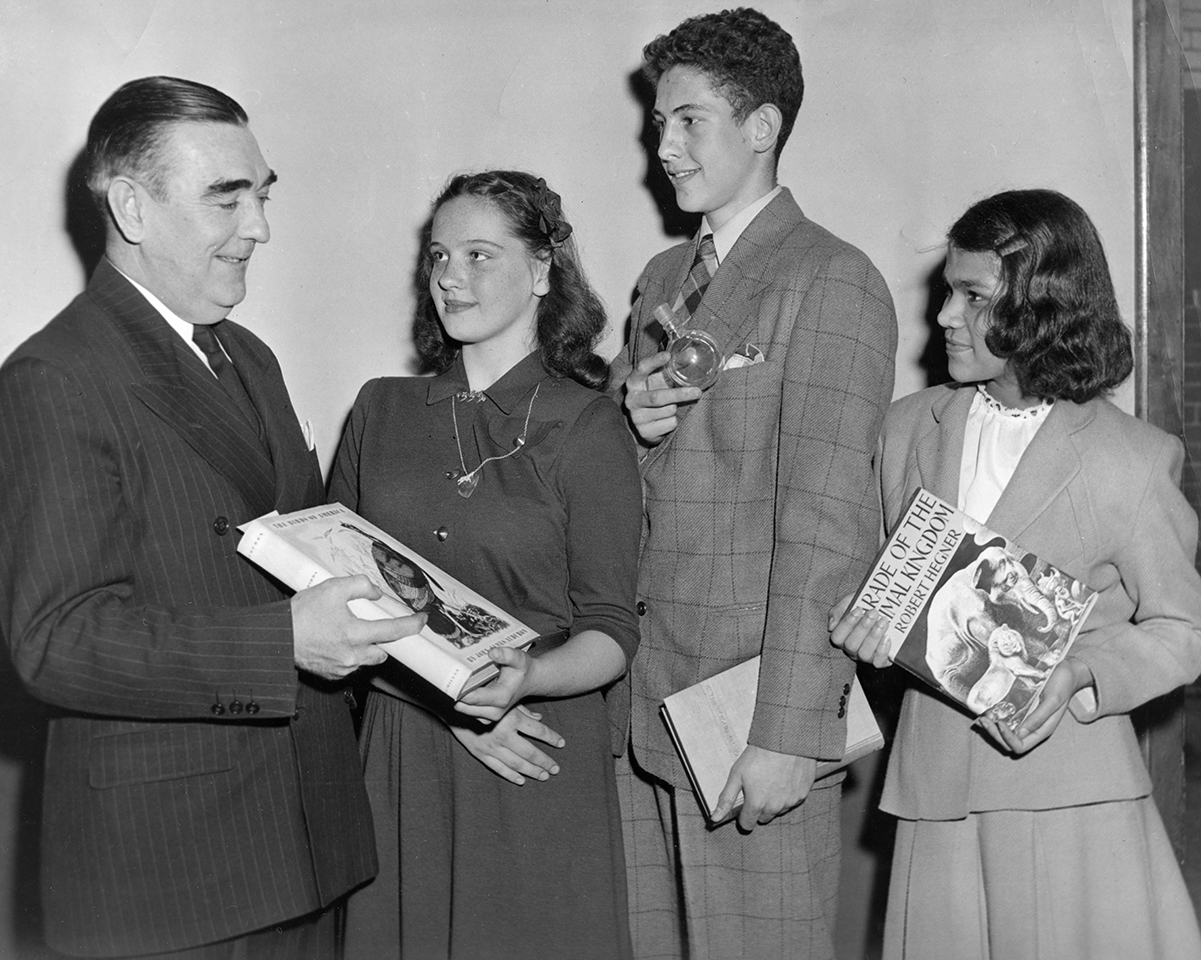
Lorraine O’Grady and Janice MacDougall, GLS ’51, winning Junior High School First Prize in the First Science Fair ever held in New England, as 8th graders. Boston, MA, Spring 1947.
1948
During this election year, O’Grady, a skillful debater and fervent supporter of the Progressive Party candidate Henry Wallace, debates daily after school at Sharaf’s Cafeteria with her competitor, Shirley Walker, an arch-Republican who supports Thomas Dewey. Other classmates also occasionally chime in over root-beer floats and brownie sundaes.
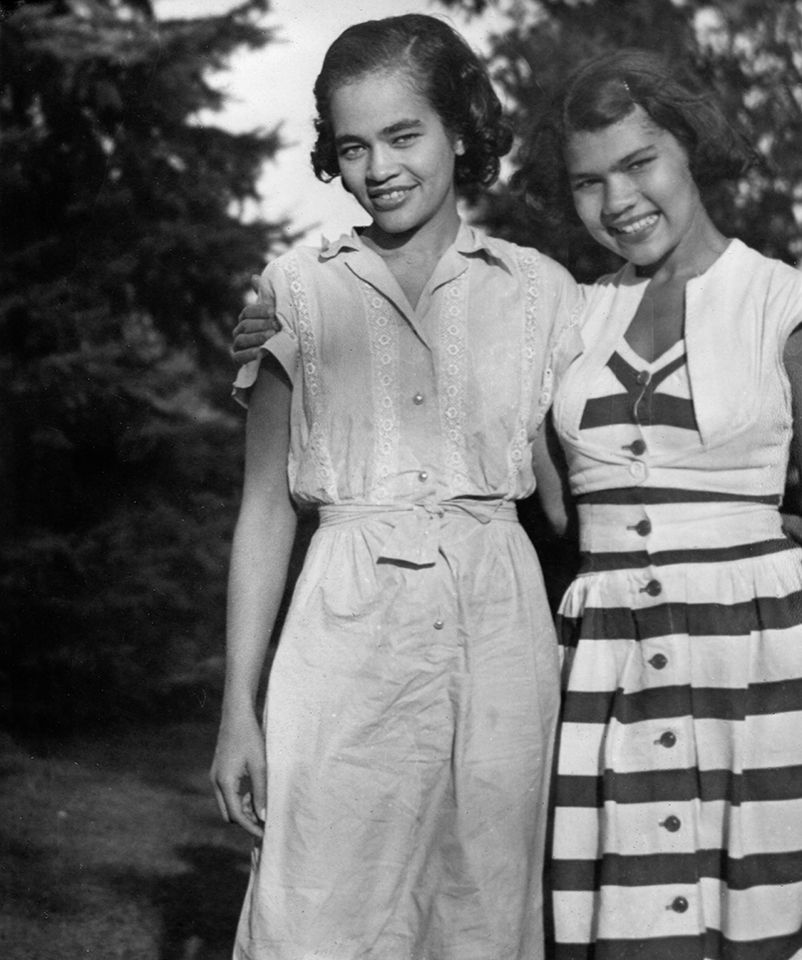
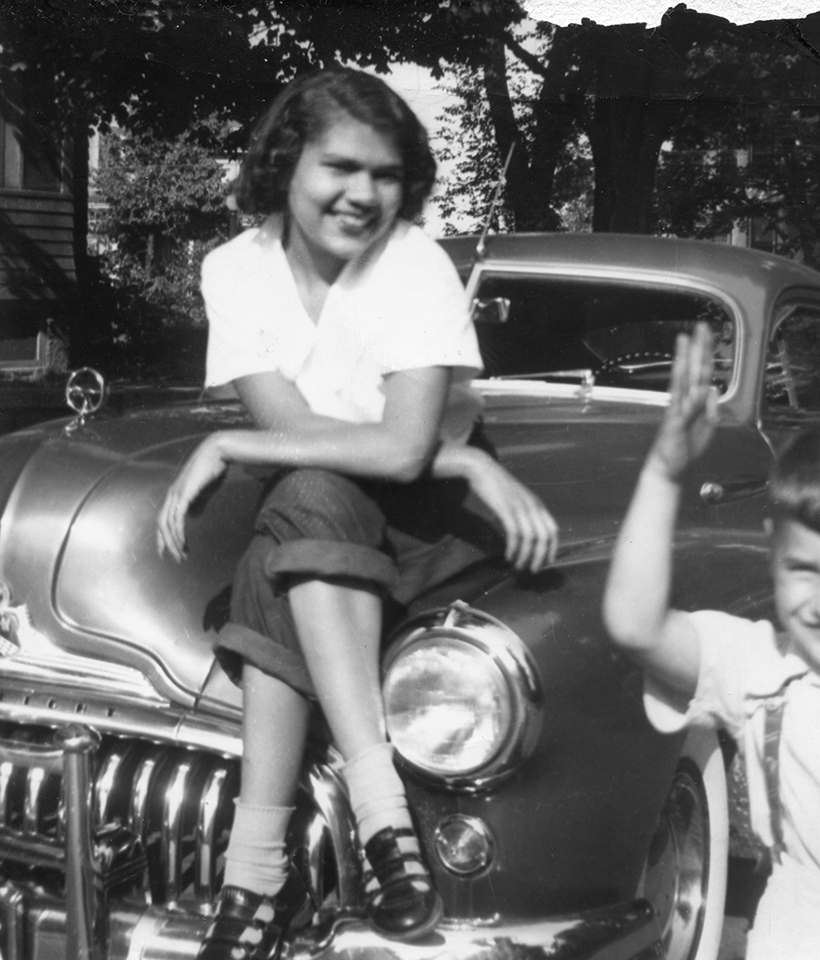
Lorraine O’Grady at the age of 13 with her sister Devonia, 1947.
1949
Active in sports, O’Grady joins the field-hockey team as a starter.
1950s
1950
In spring, she is confirmed at St. John’s by a retired bishop from New Hampshire. The church will be destroyed by fire in 1968.
1951
O’Grady graduates from Girls’ Latin, with honors in History, English, and Latin, and is named a member of the National Honor Society. She is awarded the first-ever full aid package, combining merit and need, from Wellesley College in Wellesley, Massachusetts, and begins studies in the fall. Dormitory life is typical of the era, with the college acting as in loco parentis (in place of the parent) and placing restrictions on personal behavior: dress codes and mandatory curfews. Massachusetts and Connecticut are the only two states where female contraception cannot be purchased. Despite her high scoring on her Latin College Board exams, O’Grady elects to study a contemporary language and declares Spanish literature as her major.
1952
In sophomore year, O’Grady becomes president of l’Atalaya (the Spanish Corridor), where residents commit to speaking only in Spanish during meals and all social interactions. In the regular after-dinner gatherings, their tutor, Manuela Escamilla, a young exile from Franco’s Spain, introduces Corridor residents to, among other aspects of Spanish culture, the golden age of flamenco. O’Grady will become a lifelong aficionada of flamenco dance and music. Her most intellectually transformative class is in Biblical history, in which she learns how many disciplines, from archaeology to cultural anthropology and linguistics, are required to unearth an ancient history. The course exposes O’Grady to comparative thinking through reading the Synoptic Parallels, with Matthew, Mark, and Luke laid side by side on the page. She audits a slide-lecture course in art history.
1953
On April 2, O’Grady marries Robert Clarence Jones, the star track-and-field athlete at Tufts University. They have a son, Guy David Jones, on August 2, 1953. O’Grady turns nineteen two months later.
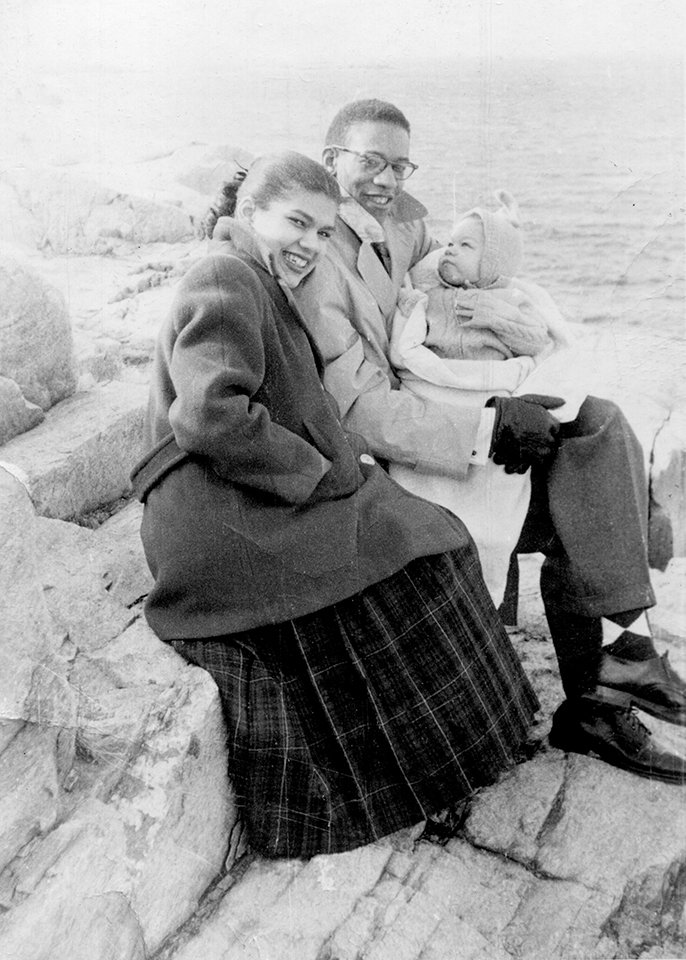
Lorraine O’Grady, her husband Bobby Jones and their son Guy, 1953.
1953–1955
O’Grady takes a year and a half off from studies at Wellesley, moving back to Boston with her husband. She takes courses full-time at Boston University and at Harvard University Summer School, to prepare for her return to Wellesley. Her parents pay for her tuition and for a babysitter so she can concentrate on her studies.
1955
In the fall, O’Grady returns to Wellesley and commutes daily from Boston to complete her coursework. At lunch, she and the twenty other married students are required to eat in a separate room at the top of Greene Hall, the administrative building.
1956
O’Grady graduates from Wellesley, earning a Bachelor of Arts degree in Economics with a minor in Spanish literature. According to custom, she remains affiliated with her entering class, the Class of 1955.
O’Grady passes exams required to enter the United States Federal Government’s elite Management Intern Program, one of only six women of two hundred people hired. She moves to Washington, DC, and begins work for the government in July. Her husband, Robert, returns to live with his parents in Brockton, Massachusetts, and attend graduate school in education. Her son remains in Boston and lives with O’Grady’s parents.
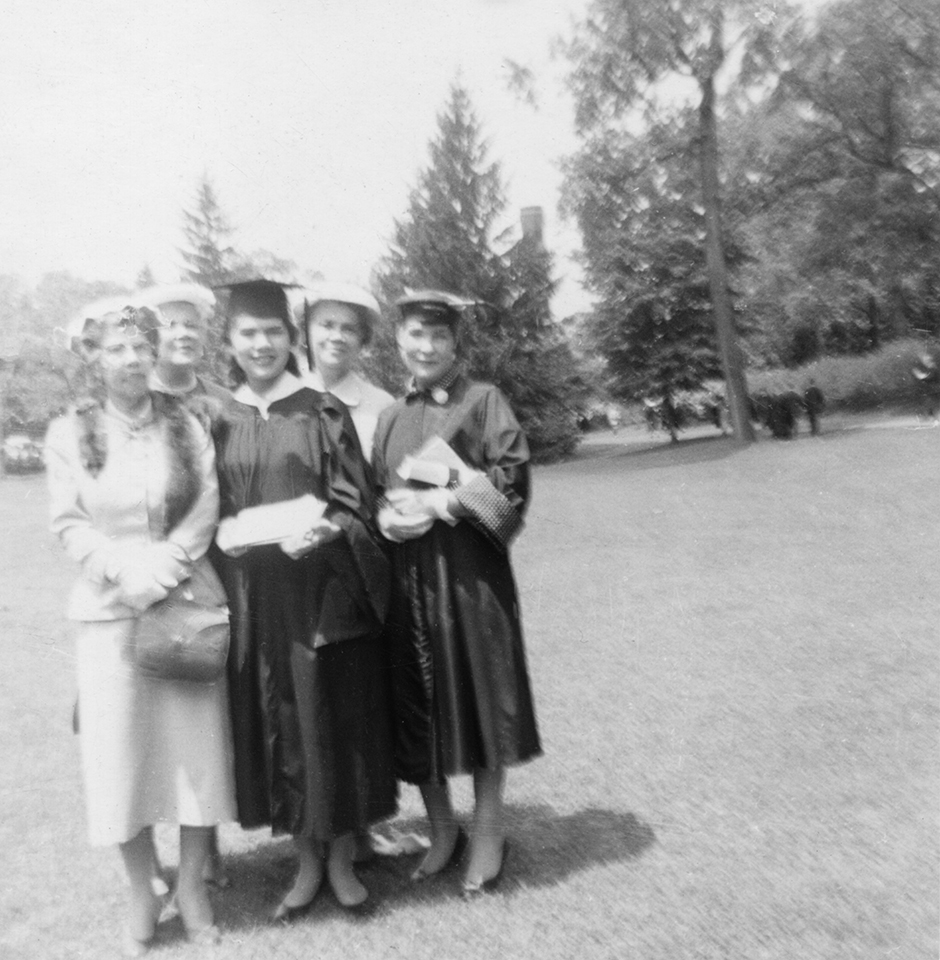
Lorraine O’Grady holding her diploma at Wellesley College campus after graduation in the summer 1956.
1957
After completing her first-year internship, O’Grady takes up her position as a research economist at the Department of Labor’s Bureau of Labor Statistics in the Division of Foreign Labor Conditions (BLS/DFLC). At BLS, she focuses on Latin America and Africa and publishes several monographs on labor conditions in various countries of those regions under the name Lorraine O’Grady-Jones. She also becomes vice chairman of the informal, government-wide Africa Study Group, whose chair is the State Department’s assistant secretary of African affairs.
1958
In summer, O’Grady sends for her son to come to live with her.
1959
O’Grady receives a no-fault divorce from Robert Jones.
1960s
1960
Following a personal crisis, O’Grady contacts Robert to ask if he will take Guy to live with him and his parents in Brockton. Robert responds affirmatively, and they agree that there will be no further changes for their son, who now needs permanent stability.
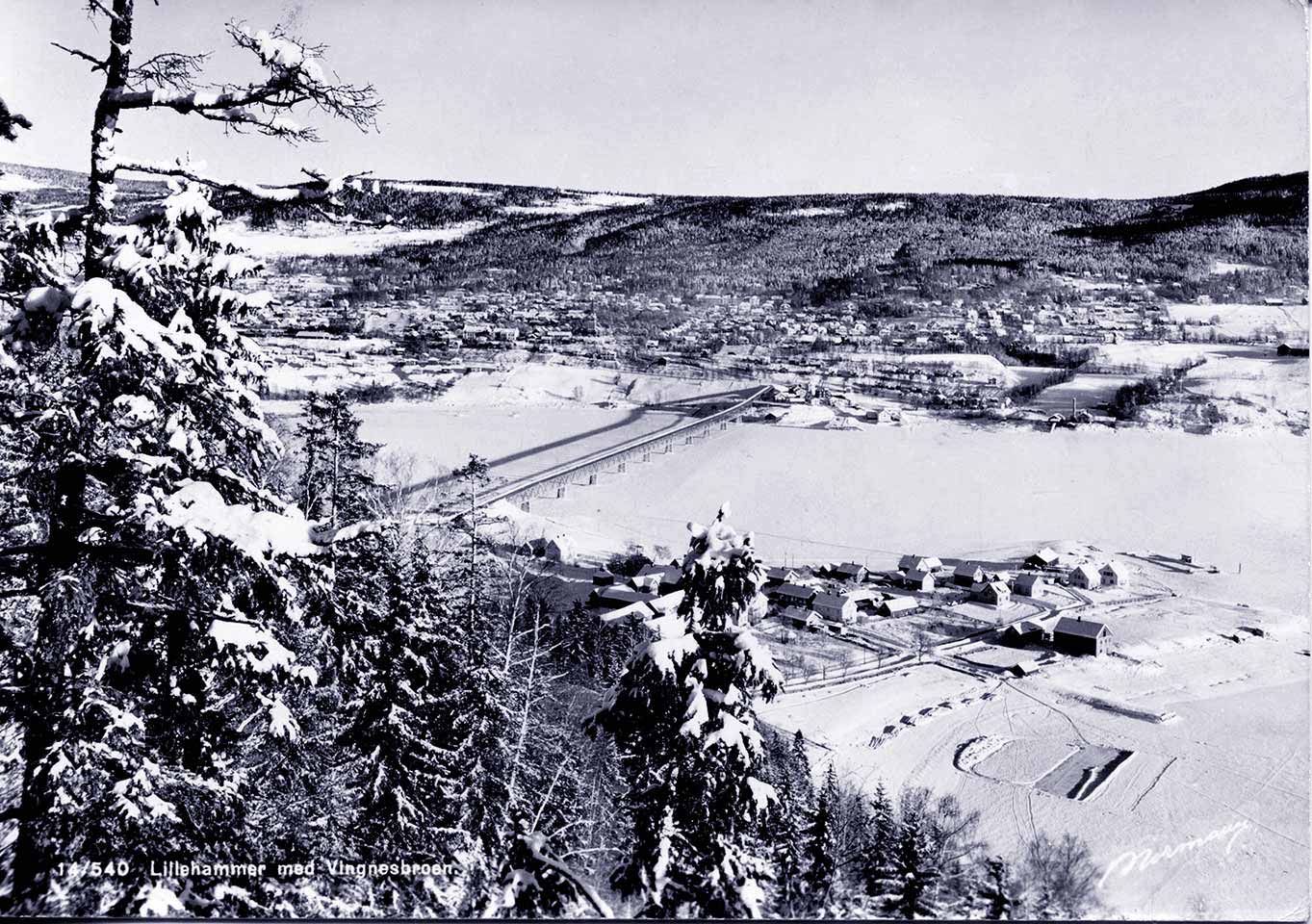
1961, Lillehammer, last stop before Espedalen, Norway, where O’Grady spent time writing.
1961
She resigns from the Department of Labor in July, convinced her personal and political goals cannot be achieved in the “grayed-out world” of government. After five years in intelligence research and analysis, she decides to try to effect change through art. Using her retirement savings, O’Grady travels to Europe and settles in Denmark for nearly a year and a half to write a novel. Touring the continent, she spends time writing in Espedalen, Norway.
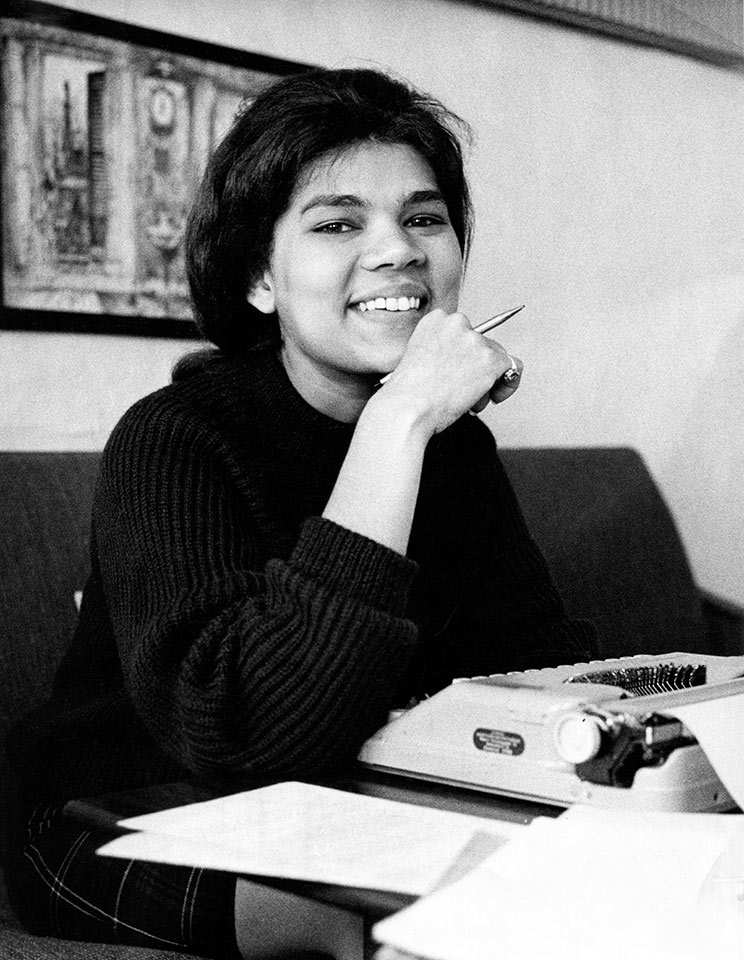
1962, O’Grady, in apartment at 55 Wildersgade, Christianshavn, Copenhagen.
1962
O’Grady’s older sister, Devonia Evangeline, dies tragically on January 13. At the end of the summer, O’Grady returns home to visit her sister’s grave, see family, and take a temporary contract at the Department of State’s Bureau of Intelligence Research, American Republics Branch (INR/ARA). Her employment begins just in time for the Cuban Missile Crisis. In addition to writing a monograph on outcomes of foreign-exchange visits, her job responsibilities now include reading up to ten national and international papers and three transcripts in Spanish of Cuban radio station broadcasts each day. O’Grady describes this time as one when language “collapsed” for her and “melted into a gelatinous pool”—experiences that would prove foundational in 1977 for her first artwork, Cutting Out the New York Times.
1963–1964
When her State Department contract ends, O’Grady travels to Ethiopia and Egypt. In Egypt, she is moved by her first experience of seeing streets filled with people who look like her. She commences in-depth research on ancient Egypt, especially the Armana period of Nefertiti and Akhenaton. Her research will become the basis for her performance Nefertiti/Devonia Evangeline in 1980, the Sisters diptychs in 1988, and Miscegenated Family Album in 1994.
1965
Returning to the United States, O’Grady again lives in Washington, DC, and teaches Spanish at the predominantly Black Eastern High School.
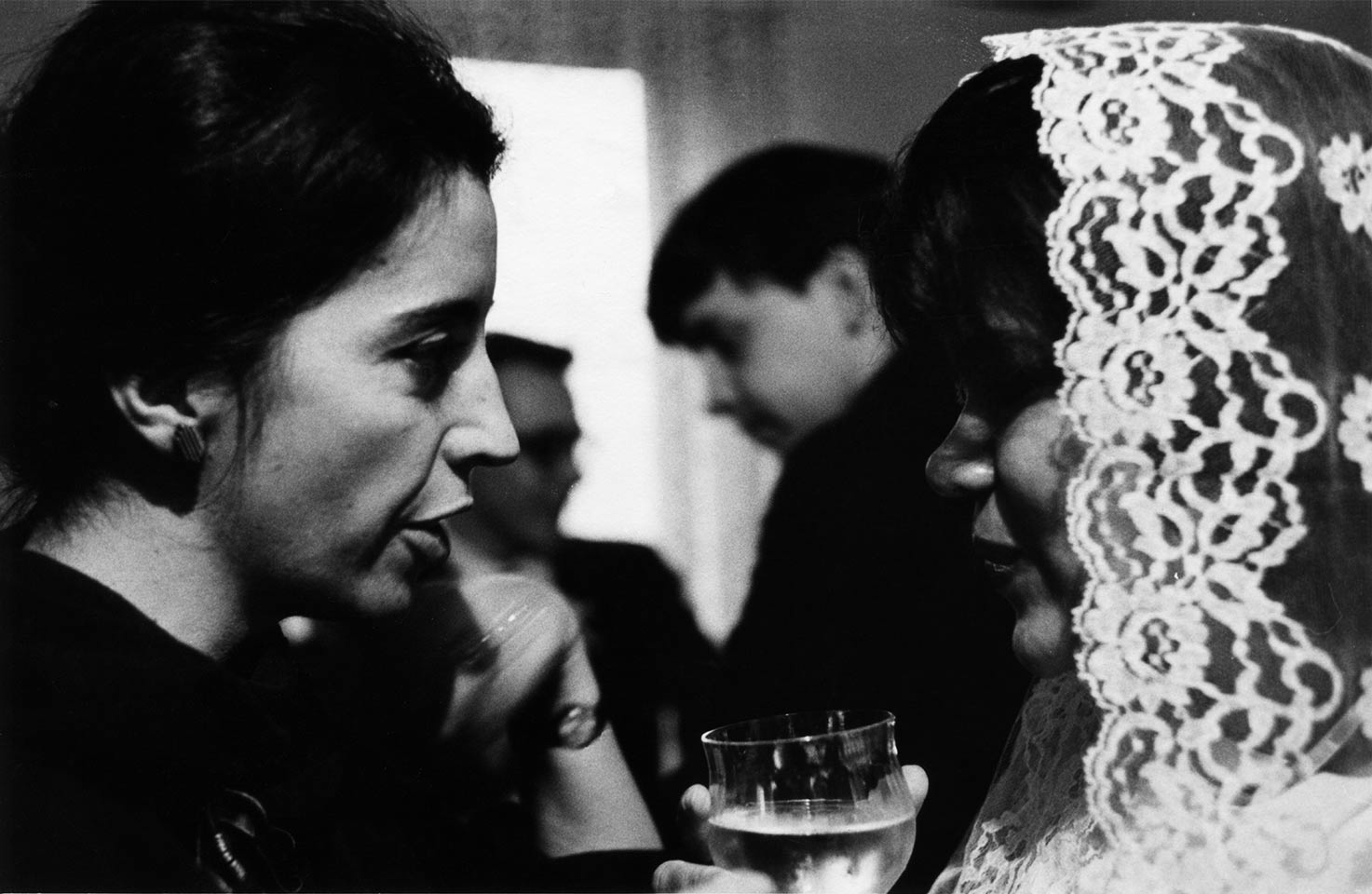
Iowa Writers Workshop, Maria Pilar, writer José Donoso’s wife, at O’Grady’s marriage to Chap Freeman in 1965.
1965–1967
O’Grady attends graduate school at the Iowa Writers Workshop, University of Iowa, studying fiction with José Donoso and taking Translation Workshop. On November 21, 1965, she marries Chappelle Freeman Jr., a fellow grad student at Iowa. While a student, she translates several of Donoso’s short stories into English, including the acclaimed “Paseo,” all of which are published under the name Lorraine O’Grady Freeman. When Chap Freeman graduates in 1967, the couple moves to Chicago, where he works in commercial film production before becoming cofounder of the film department at Columbia College. O’Grady does not complete her graduate studies.
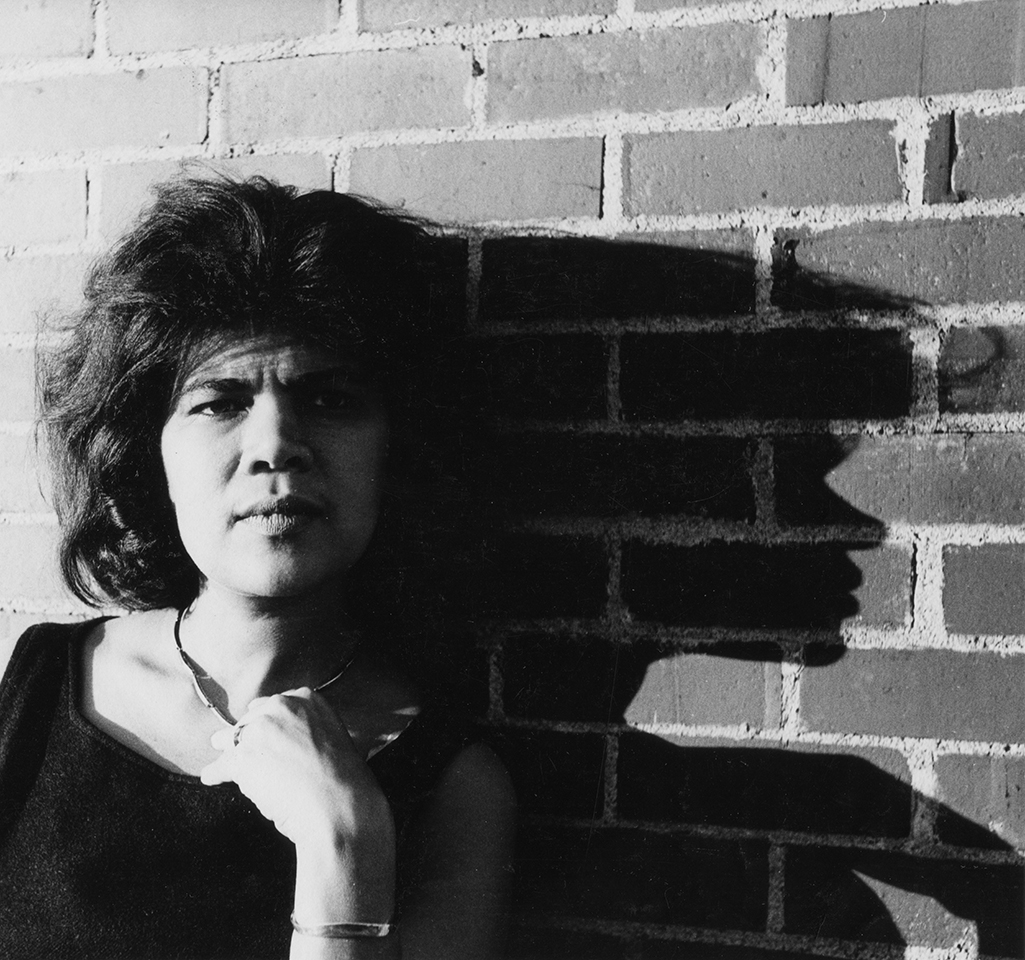
O’Grady in 1966. Photo by Chap Freeman.
1967–1968
O’Grady signs a contract with Alfred A. Knopf Publishers to translate Donoso’s second novel, Este Domingo (This Sunday), and completes the translation over the summer. She then holds several jobs in Chicago, including a brief stint as a substitute teacher at inner-city Chicago schools and another as a cocktail waitress at a Blues club managed by a friend of Freeman’s. After the Chicago riots protesting the assassination of Martin Luther King Jr., O’Grady becomes a volunteer with the Southern Christian Leadership Conference’s Operation Breadbasket, led by Jesse Jackson. She writes a memo to Jackson, “The Difference Between Power and Influence,” which he later uses as the topic for a Southern Christian Leadership Conference training week for ministers.
1968
O’Grady begins to work part-time managing the Academy Translation Bureau, where the major client is Playboy. She translates texts from Spanish, French, Portuguese, Italian, Danish, Swedish, and Norwegian into English for Hugh Hefner’s personal journals, as well as for the magazine, and hires other translators for texts in languages she does not know.
1970s
1970
O’Grady and Freeman separate.
1970–1973
After the owner of the Academy Translation Bureau passes away, O’Grady takes over the company and renames it Freeman Associates. She drops all of the clients except Playboy and successfully wins the contract to complete translations for the forthcoming third revised edition of the Encyclopedia Britannica.
1973
O’Grady moves to New York City in May after completing the Britannica translations. She begins writing rock criticism for the Village Voice, Rolling Stone, and other publications, while dating a rock-music executive. The Village Voice publishes her first article as a three-page cover story on August 2. The unsolicited three-thousand-word personal essay focuses on her experiences listening to the Allman Brothers Band while working through the issues that lead to her leaving Chicago. Its publication coincides with the band’s breakthrough performances at Madison Square Garden in New York City and Watkins Glen Gran Prix Raceway outside of Watkins Glen, New York.
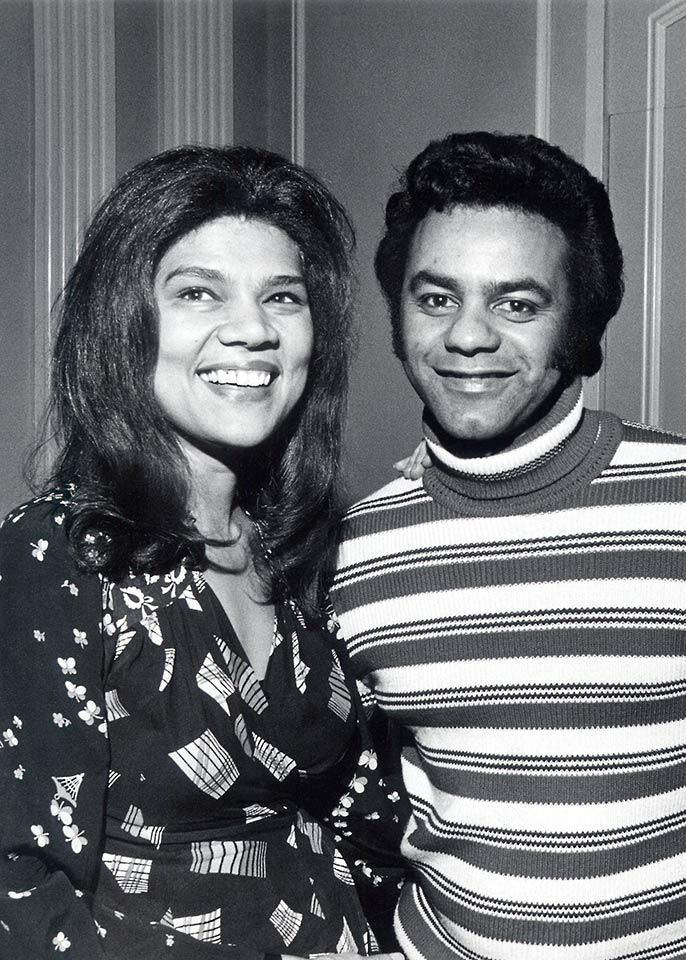
O’Grady with singer Johnny Mathis at the Columbia Records after-party for his concert at Avery Fisher Hall, New York, 1974.
1974
O’Grady begins teaching at the School of Visual Arts (SVA) after Jack Galef, a friend from the Iowa Writers Workshop, asks if she will take on one of his English courses. She will remain an adjunct instructor in the Humanities Department at SVA for twenty-six years, teaching courses on the poetry of Baudelaire and Rimbaud, and on Futurist, Dada, and Surrealist literature, among other topics. Her students will include John Sex, Keith Haring, Kembra Pfahler, Luis Stand, and Robert Ransick. Ransick becomes O’Grady’s studio assistant in 1990 and forms what will be a lifelong friendship with the artist-teacher.
To orient herself to her new surroundings at SVA, O’Grady begins a self-created crash course in contemporary art. At the Eighth St. Bookshop, the first book she picks up is Lucy Lippard’s Six Years: The dematerialization of the art object from 1966–1972, published in 1973. The book deeply resonates with her and encourages her to consider a career in performance and conceptual art.
O’Grady’s father passes away.
1977
Each Sunday from June 5 to November 20, O’Grady makes Cutting Out the New York Times, a series of twenty-six poems made with words and phrases cut from the influential newspaper American paper of record. She begins the work while reading the Sunday Times for source material to make a collaged thank-you card for her doctor after a biopsy of her breast tissue came back negative. After completing the series, O’Grady would never again buy the Sunday Times.
1978
O’Grady begins attending performances at Franklin Furnace, sometimes twice a week, and continues to do so for two years, learning by observing artists of varied styles and concerns, from New York and as far away as Australia. She later tells Martha Wilson, the founder of the Furnace, that she took her “MFA in Performance” there.
1978–1979
O’Grady writes a script, The Dual Soul, which consists of two performances: Part 1: Divine Twins and Part 2: Come into Me, You. She conceives of each part as a distinct performance and imagines them as performed by the protagonist of a film script she will write. Combining elements of Vodou, Surrealism, and 1970s chic, The Dual Soul will center on a Black female artist and her development from a position of division and struggle to one of multiplicity and acceptance. However, the film script is eventually abandoned as too ambitious for her current resources.
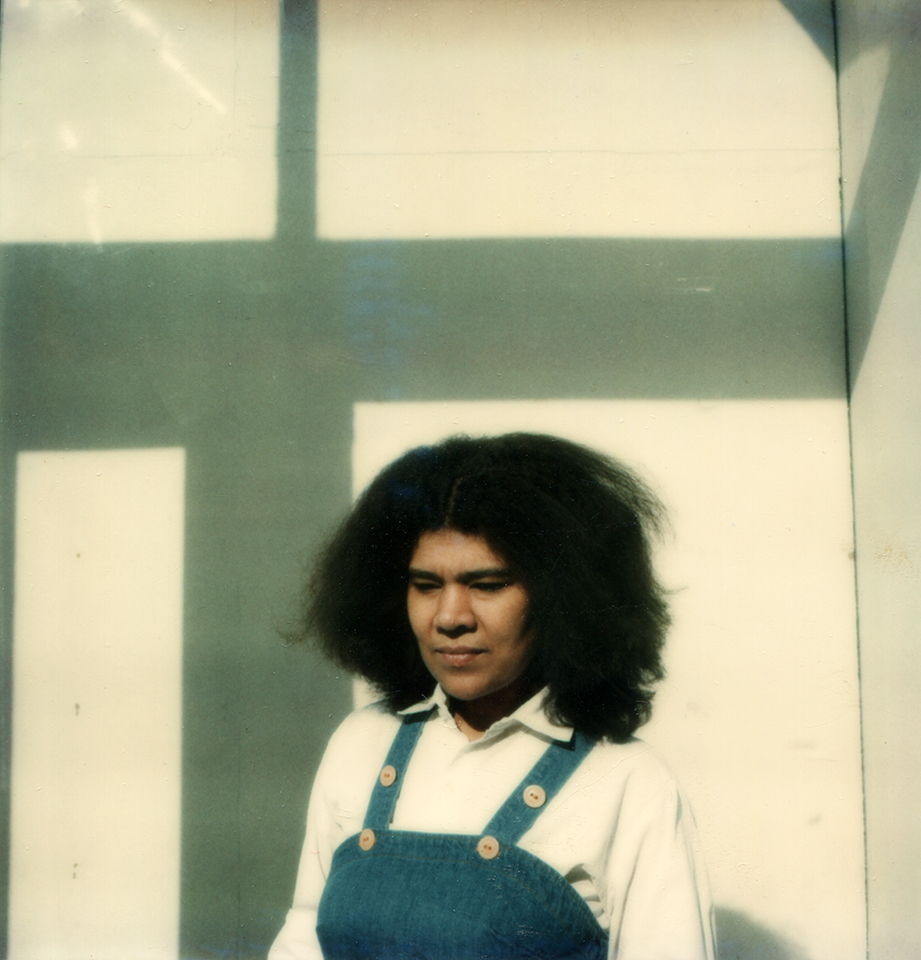
O’Grady in the late 1970s. Photographer unknown.
1979
O’Grady is in the audience when Eleanor Antin performs as her alter ego Eleanora Antinova, the Black ballerina, at 80 Langdon Street in San Francisco. The experience confirms her growing resolve to address invisible aspects of Blackness and to speak for herself.
1980s
1980
On February 17, O’Grady attends the opening of Afro-American Abstraction at the Institute for Art and Urban Resources, or PS1, in the Queens neighborhood of Long Island City. She is struck by the possibilities for intellectual companionship evidenced in the Black art community, while formulating her own critical take on the work in the exhibition, deeming it too cautious.
In early April, O’Grady begins working as a volunteer at Just Above Midtown Gallery (JAM), a nonprofit gallery founded by Linda Goode-Bryant to support the work of Conceptual and other avant-garde African American artists. She takes on public relations and writing duties for the gallery, which has moved from Fifty-Seventh Street to Franklin Street in Tribeca.
While O’Grady is working at JAM, her politics begin to change from “post-Black” to “Black.” In drumming up coverage for the gallery’s first show in its downtown space, Outlaw Aesthetics, she speaks with the editor of the New Yorker’s “Goings On about Town” regarding coverage for the gallery. During the conversation, the editor responds to the title of JAM’s show by saying, “Oh, they always put titles on shows there, don’t they?” O’Grady later cites this interaction as catalyzing her political shift, as she recognized that neither JAM nor any other Black galleries had been listed in the New Yorker.
On May 7, at New York’s Westbeth Gallery, O’Grady presents selections from Cutting Out the New York Times for the first time.
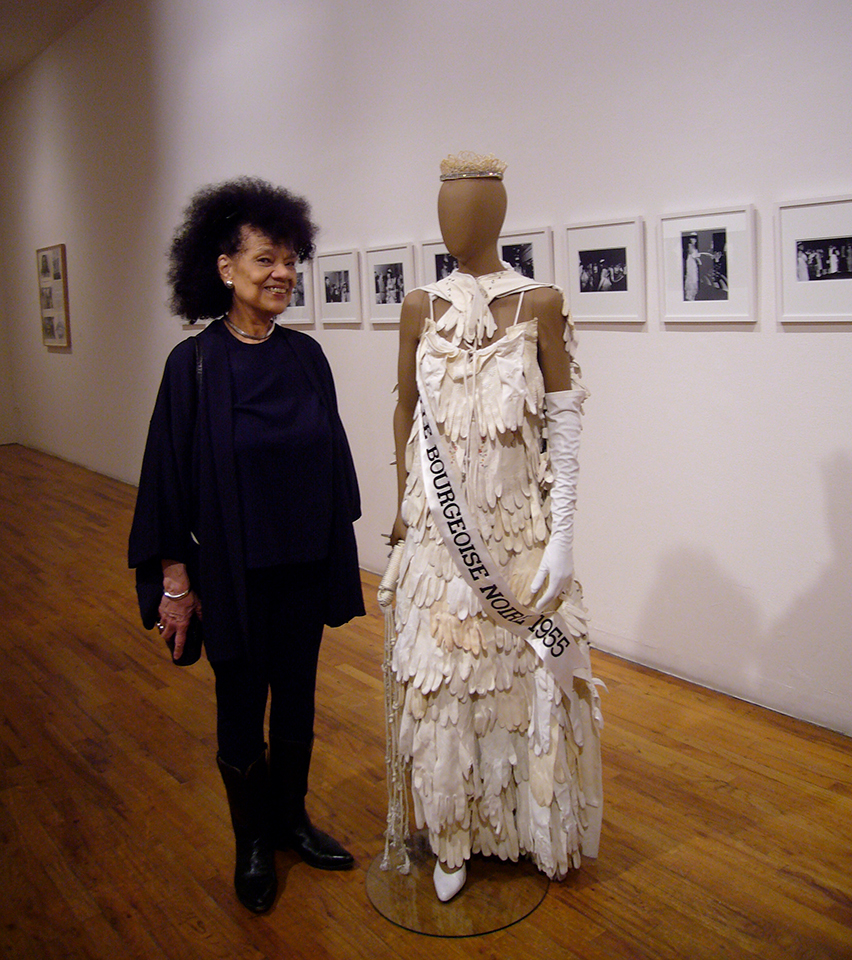
On June 5, O’Grady gives her first public performance as Mlle Bourgeoise Noire at the opening of Outlaw Aesthetics. Linda Goode-Bryant then invites O’Grady to represent JAM as part of Dialogues, an exhibition curated by Goode-Bryant that will bring together nearly a dozen downtown alternative art spaces. O’Grady creates Nefertiti/Devonia Evangeline, a work critically mourning O’Grady’s deceased older sister.
On October 31, N/DE is performed for the first time, posing a historical comparison between the ancient Egyptian queen Nefertiti and her younger sister Mutnedjmet and O’Grady and Devonia.
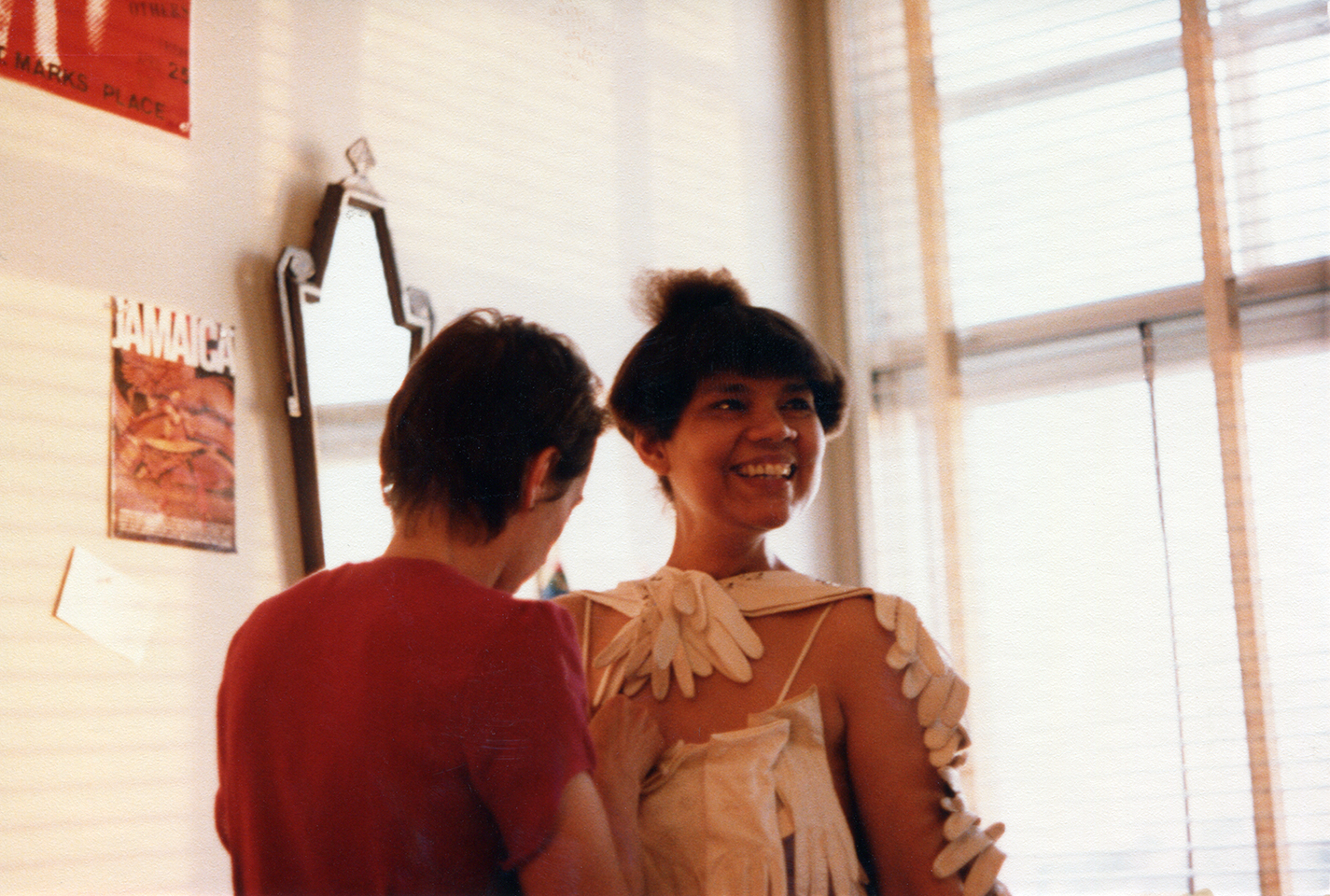
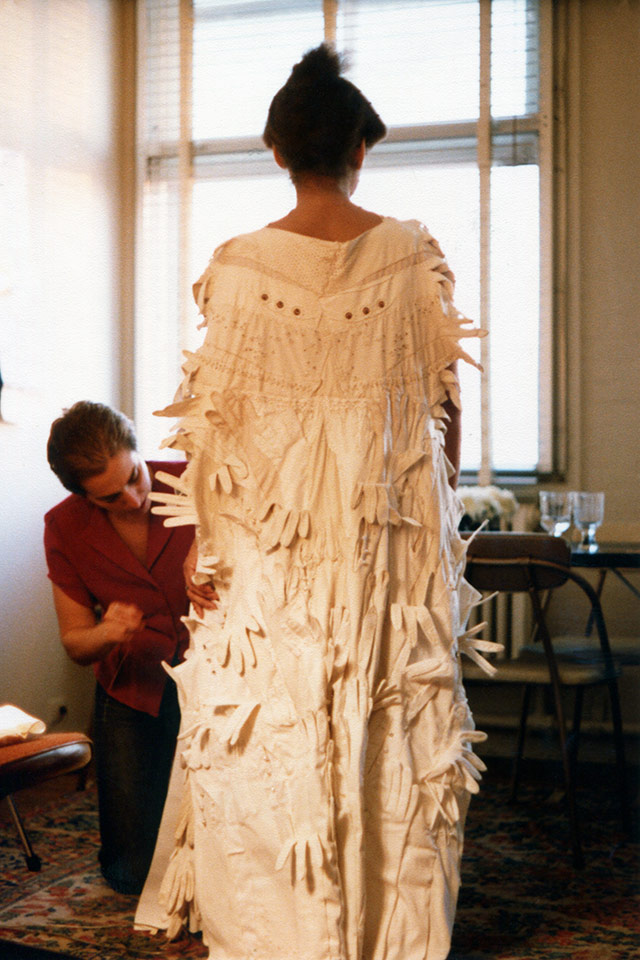
Ellen Rosen helps Mlle Bourgeoise Noire dress for a performance at Just Above Midtown Gallery in New York, 1980.
1981
On March 6, O’Grady performs Nefertiti/Devonia Evangeline for the second time in Acting Out, a performance-art series curated by Lucy Lippard at Elizabeth Irwin High School in New York.
On March 20, Mlle Bourgeoise Noire presents a performance and lecture, Gaunt Gloves, at JAM.
On September 18, Mlle Bourgeoise Noire appears at the New Museum for the opening of Persona, an exhibition that presents the work of nine contemporary artists who assume personae in their practices. After her guerrilla performance, the New Museum rescinds its earlier invitation to her to work with its education department on tours of the exhibition.
On November 20, O’Grady performs Nefertiti/Devonia Evangeline at the Feminist Art Institute in New York.
Alongside C. Carr, Carole Gregory, Lucy Lippard, Ana Mendieta, and others, O’Grady is invited by the feminist collective Heresies to work on a forthcoming issue on racism.
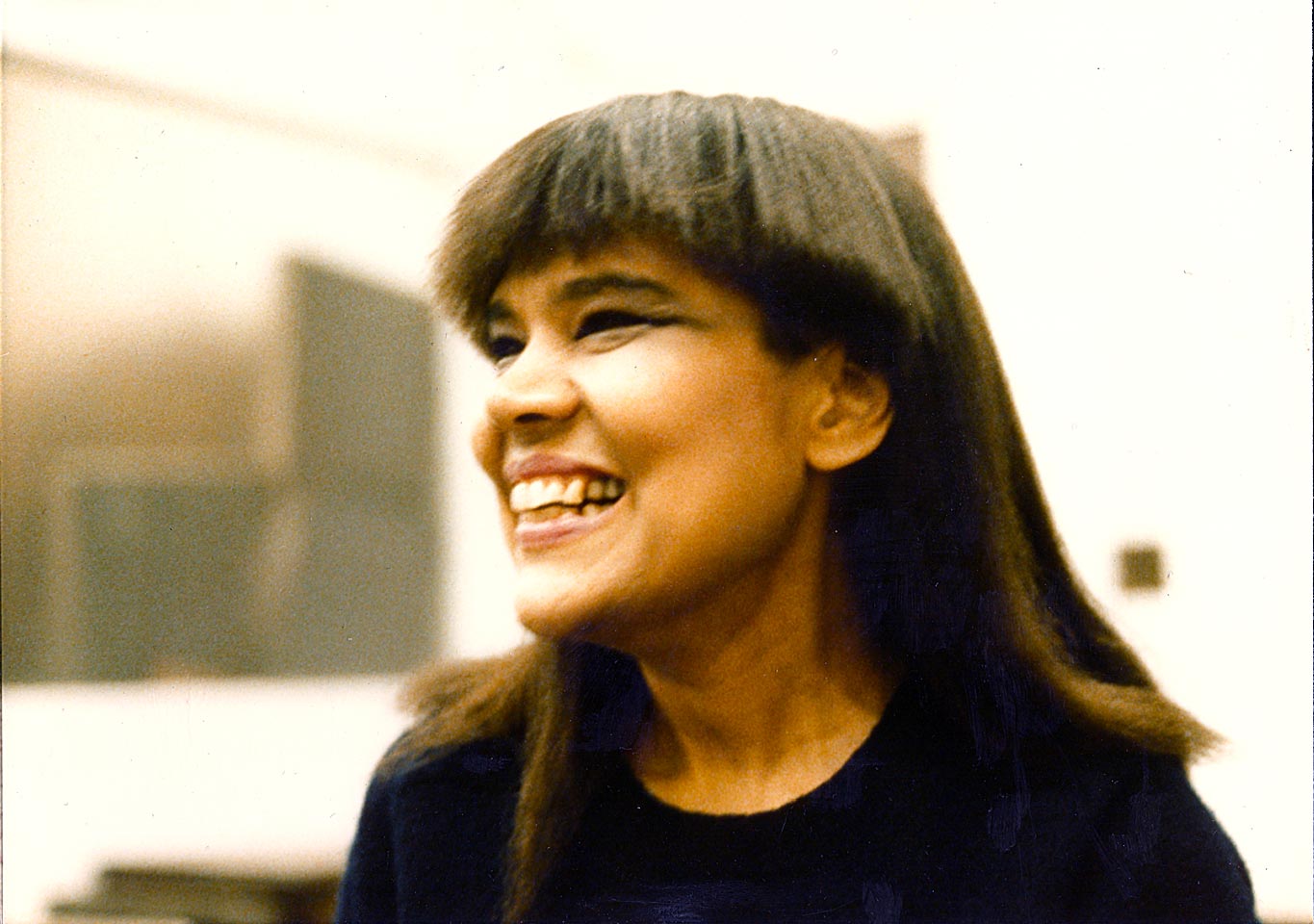
O’Grady after performing “Nefertiti/Devonia Evangeline” at the New York Feminist Art Institute in 1981.
1982
Heresies publishes an artist page, Mlle Bourgeoise Noire Goes to the New Museum, in the fourteenth issue of Heresies, The Women’s Pages. O’Grady publishes “Black Dreams” in Heresies, no. 15, in its issue on racism, Racism Is the Issue; it is her first attempt to address issues around Black female subjectivity in a public forum. One member of the issue’s editorial collective, a Black female social worker, tells O’Grady that “avant-garde art doesn’t have anything to do with black people.” This comment will compel O’Grady to make Art Is . . . the next year.
On March 11, O’Grady performs Nefertiti/Devonia Evangeline at the Allen Memorial Art Museum at Oberlin College in Ohio, at the invitation of curator William Olander.
On June 22, O’Grady—in the role of Mlle Bourgeoise Noire—sends a letter to thirty-five “Advanced Black Artists,” asking a series of questions about race and representation in contemporary art and art history.
On August 18, at the Loch in northern Central Park, O’Grady performs Rivers, First Draft, a work she has created for Art across the Park, curated by Horace Brockington, Gylbert Coker, and Jennifer Manfredi. The cast and crew of twenty includes Fred Wilson and George Mingo, and the piece is performed for an invited audience of no more than forty people, most of whom are part of the JAM community. O’Grady considers Rivers, First Draft to be the most feminist work of her career.
1982–1983
O’Grady conceives of a new character, Crow Jean, who is intended to “assist” Mlle Bourgeoise Noire in haranguing the Black middle class, and appeals to the Guggenheim Foundation for funding. Crow Jean is inspired by “Black American blues lyrics and the syncretic religions of the Caribbean.”
From spring 1982 to winter 1983, O’Grady works on a commercial project involving art by Black artists working in abstraction to be purchased by the Independence Bank, a Black-owned bank in Chicago. She creates the list of artists, visits studios, and makes all initial selections on behalf of the Brahms/Jackson interior design firm, in collaboration with Ellen Sragow, Inc., a private art dealer. The project is featured in the July 1983 issue of the magazine Interior Design.
1983
On February 10, O’Grady performs Fly by Night with Andrew Nahem at Franklin Furnace, New York, as part of Cric Crac/Nocturne, curated by Horace Brockington. The performance explores two nocturnal realms, dream and performance, through the character of Mlle Bourgeoise Noire. It consists of slides of Mlle Bourgeoise Noire at the New Museum projected behind O’Grady as she performs dream motifs that have contributed to her development and performances of her alter ego. Nahem, as the ringmaster, satirically comments on the proceedings.
In April, O’Grady, as her persona Mlle Bourgeoise Noire, curates The Black and White Show at Kenkeleba Gallery on East Second Street in New York City. Organized in the span of three weeks, and on view from April 22 to May 22, the show includes twenty-eight artists—fourteen of whom are Black and fourteen are white and all the works are in black-and-white.
On September 17, O’Grady, also in the guise of Mlle Bourgeoise Noire, stages Art Is . . . in the Afro-American Day Parade, which takes place annually in the Harlem neighborhood of New York City. The work consists of a float—a flatbed trailer—supporting a 9-by-15-foot gold frame and performers who carry smaller gold frames into the crowds lining the streets. O’Grady has pinned her own white gloves, saved from the months spent job hunting in her last year at Wellesley, to her white shirt to signal the presence of Mlle Bourgeoise Noire. O’Grady decides to enter her float in the Afro-American Day Parade in Harlem rather than the West Indian Day Parade in Brooklyn both because she does not think “avant-garde art [can] compete with real carnival art” and because she wants to present the work in an environment unfamiliar to her rather than in the West Indian community, where she would feel more at home. O’Grady only tells friends from JAM and Heresies about the project, which is supported by funds from the New York State Council on the Arts, and will later share slides of it only with Lucy Lippard.
1983
O’Grady’s mother is diagnosed with Alzheimer’s disease in June but does not enter a nursing home until 1988. O’Grady begins to commute between Boston and New York, continuing to teach at SVA while becoming her mother’s primary caregiver and giving up her art practice until July 1988.
1988
O’Grady makes her first wall piece, a group of four diptychs titled Sisters, which years later, in 1994, evolves into Miscegenated Family Album. The four diptychs are presented in Art as a Verb curated by Lowery Stokes Sims and Leslie King Hammond at the Maryland Institute College of Art in Baltimore from November 21 to January 8, 1989.
1989
On April 7, O’Grady performs Nefertiti/Devonia Evangeline for the last time at the Maryland Institute College of Art.
1989–1992
O’Grady returns to translation work with a new contract with Citibank to translate ATMs into multiple languages. She continues teaching at SVA, and in 1990 begins work for her first solo gallery exhibition.
1990s
1991
O’Grady’s first solo show, Critical Interventions: Photomontages, curated by Judith Wilson, is on view at the art gallery INTAR (International Art Relations) from January 21 to February 22. For the exhibition, O’Grady creates the group of photomontages Body Is the Ground of My Experience. Rather than identifying the work as a series, the exhibition title addresses the concerns that shape her thinking during this period.
O’Grady becomes a member of the Fantastic Coalition of Women in the Arts, a reading group of women artists and art professionals, a membership that continues through 1992.
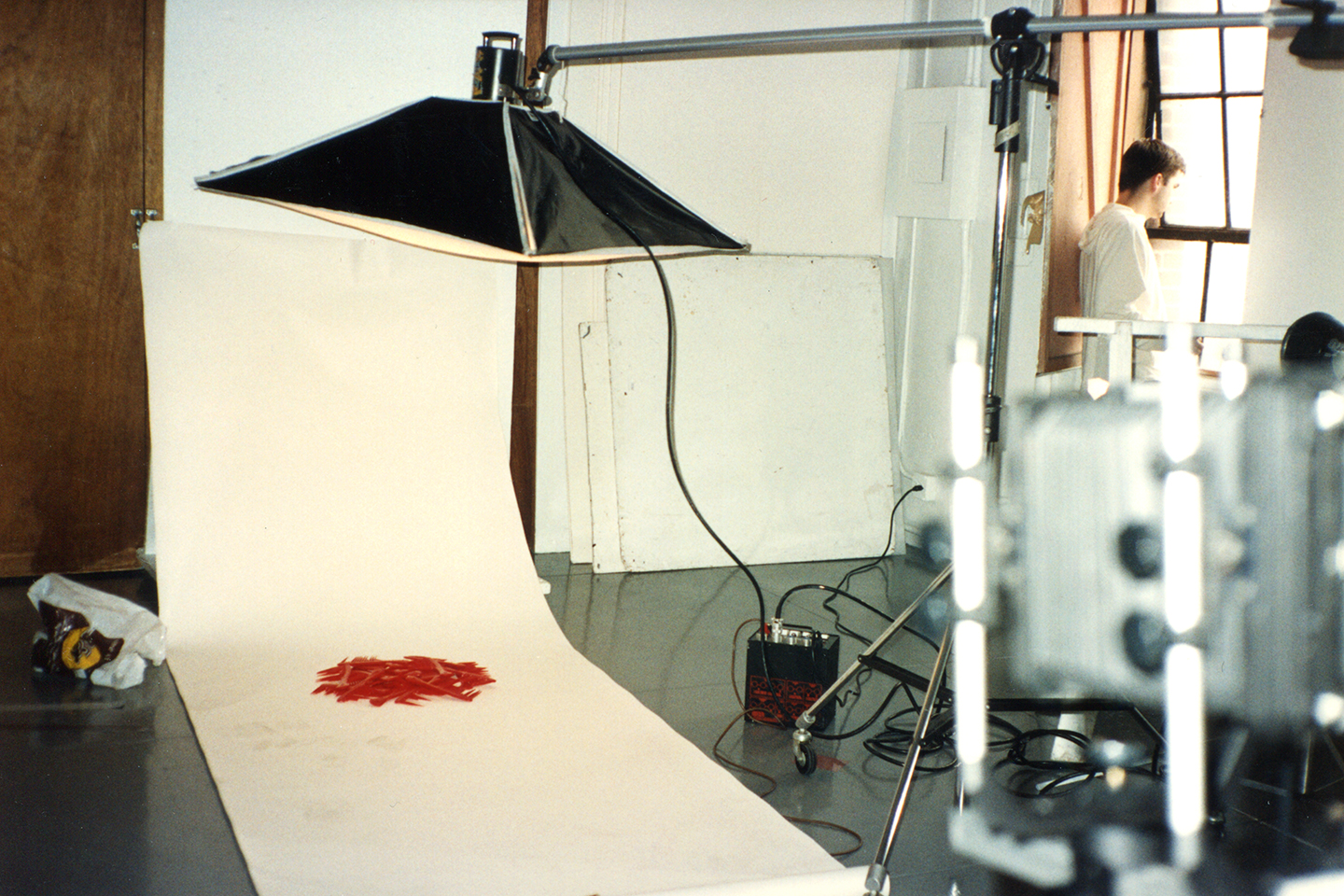
O’Grady and Robert Ransick working on a series of photomontages, later known as Body Is The Ground of My Experience.
1992
O’Grady writes the first of two sections of “Olympia’s Maid: Reclaiming Black Female Subjectivity,” which is published in the summer issue of the journal Afterimage.
O’Grady’s mother, Lena, passes away in her Brookline nursing home and is buried with her husband, Edwin, in the family plot in the Gardens of Gethsemane, a cemetery on the site of the nineteenth-century Transcendentalist community, Brook Farm, in West Roxbury, Massachusetts.
1992–1993
O’Grady writes the second of two sections of “Olympia’s Maid: Reclaiming Black Female Subjectivity,” called Postscript.
She is active in the Women’s Action Coalition (WAC), an activist group founded by women in the New York art world, cofounding its Committee on Diversity and Inclusion with filmmaker Ela Troyano.
1993
The Clearing: or Cortés and La Malinche, Thomas Jefferson and Sally Hemings, N. and Me, a diptych from Body Is the Ground of My Experience, is chosen to be included in Coming to Power: 25 Years of Sexually X-plicit Art by Women, curated by Ellen Cantor at David Zwirner Gallery and Simon Watson/The Contemporary in New York. The diptych is split up without O’Grady’s permission, and the right half, Love in Black and White, is left out of the show.
1993–1994
While in residence at the Marie Walsh Sharpe Art Foundation, O’Grady begins working on Miscegenated Family Album, a wall installation of sixteen diptychs from the original sixty-five slide pairings from her 1980 performance Nefertiti/Devonia Evangeline. The work is completed and shown in 1994 in The Body as Measure, curated by Judith Hoos Fox at Wellesley College’s Davis Museum and Cultural Center.
1994
“Olympia’s Maid: Reclaiming Black Female Subjectivity,” complete with a new postscript, is published in New Feminist Criticism: Art, Identity, Action, edited by Joanna Frueh, Cassandra L. Langer, and Arlene Raven.
1995
O’Grady begins working on Studies for Flowers for Evil and Good during her year as a Visual Arts Fellow at the Bunting Institute of Radcliffe College at Harvard University, Cambridge, Massachusetts, and shows the work-in-progress at the Bunting in an unadvertised show called The Secret History.
1996
O’Grady first publicly shows two works from Studies for Flowers of Evil and Good at the Institute of Contemporary Art, Boston, in the group exhibition New Histories.
Laura Cottingham interviews O’Grady for Artist and Influence 1996, a journal published by the Hatch-Billops Collection.
1998
A newer, more fully developed version of Studies for Flowers of Evil and Good is shown at Thomas Erben Gallery, which now represents the artist in New York.
1999
O’Grady accepts two resident faculty positions, one at the Skowhegan School of Painting and Sculpture in Maine and the other at the International Summer Academy of Fine Art in Salzburg, Austria.
2000s
2000
After twenty-six years teaching at the School of Visual Arts, O’Grady accepts a position at the University of California, Irvine, as an assistant professor in the department of Studio Art and in the program in African American Studies. She will teach courses on contemporary art, issues in diaspora and hybridity, the Black female body, and Working in Series, a studio art course, until 2005.
2005
O’Grady moves back to New York.
2006
In March, artist Nick Mauss includes five poems from the full Cutting Out the New York Times series in the exhibition he curates, Between the Lines, at Daniel Reich Temporary at the Chelsea Hotel, nearly thirty years after O’Grady completed the work.
2007
The Mlle Bourgeoise Noire dress and photographic documentation of Mlle Bourgeoise Noire at the New Museum are included in WACK! Art and the Feminist Revolution, the first museum exhibition to explore the originating period of feminist art, curated by Connie Butler at the Museum of Contemporary Art, Los Angeles.
O’Grady launches her website as an archive of her work.
O’Grady makes her first multichannel video installation, Persistent, at Artpace in San Antonio, Texas.
2008
Alexander Gray Associates begins representing O’Grady. Miscegenated Family Album is seen in its entirety for the first time in New York in her first show at the gallery.
O’Grady receives an Anonymous Was a Woman Award.
2009
Art Is . . . is shown for the first time as a wall-based installation by Alexander Gray Associates at Art Basel, Miami Beach, Florida. It consists of forty photographs gathered from friends and bystanders who witnessed the performance.
When Michael Jackson dies on June 25, O’Grady surprises herself by the depth of her emotion and grief and begins conducting extensive research on Jackson.
2010s
2010
For the 2010 Whitney Biennial, curated by Francesco Bonami and Gary Carrion-Murayari, O’Grady creates The First and the Last of the Modernists, connecting Jackson with poet Charles Baudelaire.
At Kunsthalle Basel in Switzerland, O’Grady shows the full series of Cutting Out the New York Times in a two-person installation with Nick Mauss, curated by Adam Szymczyk.
For the 2010 Buffalo Biennial, O’Grady creates and exhibits her first single-channel video, Landscape (Western Hemisphere), executive produced by Carolyn Tennant, director of New Media, Hallwalls, Buffalo.
Judith Richards interviews O’Grady for the Smithsonian Institution’s Archives of American Art, Washington, DC.
O’Grady’s papers are acquired by the Wellesley College Archives, the institution’s first major acquisition of alumnae papers. The Lorraine O’Grady Papers at Wellesley College will officially open with a complete finding aid in 2012.
2011
O’Grady receives the United States Artists Rockefeller Fellowship in Visual Art.
2013
O’Grady returns to the Skowhegan School of Painting and Sculpture as a visiting faculty member.
2014
O’Grady receives the College Art Association’s Distinguished Feminist Award.
2015
For En Mas’: Carnival and Performance Art of the Caribbean, a traveling show that opens at the Contemporary Arts Center, New Orleans, curated by Claire Tancons and Krista A. Thompson, O’Grady’s contribution is an installation of a new documentary research video, Looking for a Headdress. The video is an offshoot of her preparatory work for Announcement of a New Persona (Performances to Come!).
In collaboration with Kodak, O’Grady produces prints of the photographic documentation of the 1982 performance Rivers, First Draft and shows the work for the first time at Alexander Gray Associates.
A solo exhibition of O’Grady’s Art Is . . . is held at the Studio Museum in Harlem, curated by Amanda Hunt.
The exhibition Lorraine O’Grady: Where Margins Becomes Centers, curated by James Voorhies, is mounted at the Carpenter Center of Visual Art at Harvard University.
O’Grady receives Howard University’s James A. Porter Colloquium in African American Art Lifetime Achievement Award.
2016
O’Grady stars in British-American singer and visual artist Anohni’s music video for the track “Marrow,” from her 2016 album Hopelessness.
O’Grady has a survey show, Initial Recognition, at the Centro Andaluz de Arte Contemporáneo, Sevilla, Spain, curated Berta Sichel and Barbara Krulik.
2017
The Mlle Bourgeoise Noire dress plus photographic documentation of Mlle Bourgeoise Noire at the New Museum, as well as a selection of images from Rivers, First Draft are included in We Wanted a Revolution: Black Radical Women, 1965–85, curated by Catherine Morris and Rujeko Hockley with A.L. Rickard at the Brooklyn Museum.
O’Grady creates a new body of work, Cutting Out CONYT, composed of twenty-five haiku diptychs and a single-panel statement, reworked from her 1977 Cutting Out the New York Times.
2018
In September, O’Grady shows the full Cutting Out CONYT series for the first time, together with the video Landscape (Western Hemisphere), in her solo exhibition From Me to Them to Me Again, curated by Storm Janse van Rensburg at the Savannah College of Art and Design Museum of Art in Savannah, Georgia. She identifies the poetic work as signaling her new political shift from Black to post-post-Black.
In October, important selections from Cutting Out CONYT are exhibited in a solo show at Alexander Gray Associates, New York.
2019
On April 19, 20, and 22, O’Grady performs at the Kitchen, New York, in Anohni’s surrealistic She Who Saw Beautiful Things, created and with music composed by the musician-visual artist to accompany her exhibition Love, also on view. Both are a memorial to Anohni’s recently deceased friend and mentor, Dr. Julia Wasuda. O’Grady’s role is that of Li-A, an aspect of Julia.
On April 23, O’Grady receives the Skowhegan Medal for Conceptual and Cross-Disciplinary Practices.
On April 27, she delivers the talk “Interstice” at Loophole of Retreat, a conference organized by Simone Leigh, Tina Campt, and Saidiya Hartman, as part of Leigh’s Hugo Boss Prize exhibition at the Solomon R. Guggenheim Museum, New York.
2020s
2020
O’Grady adapts her Body Is the Ground of My Experience photomontage, The Strange Taxi: or From Africa to Jamaica to Boston in 200 Years, for a monumental new work, The Strange Taxi Stretched, which is installed on the façade of the Isabella Stewart Gardner Museum in Boston. The installation coincides with the exhibition Boston’s Apollo, also at the museum, which highlights Thomas McKeller, the young Black model who posed for most of the figures in John Singer Sargent’s murals in the Museum of Fine Arts, Boston. O’Grady writes the essay “Notes on Living a Translated Life” for the catalogue to the exhibition.
O’Grady’s book of collected writings, Writing in Space, 1973–2019, introduced and edited by Aruna D’Souza, is published by Duke University Press.
2021
Lorraine O’Grady: Both/And, the first retrospective of her career, opens at the Brooklyn Museum in March.