
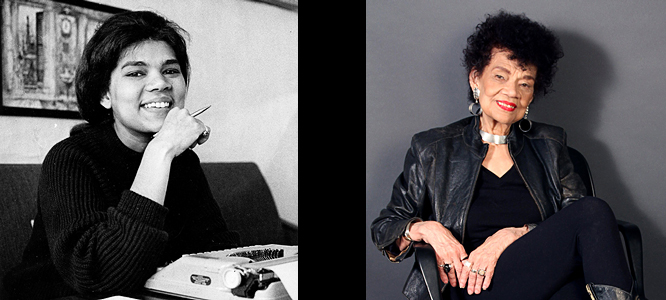
Lorraine O’Grady Obituary
Lorraine O’Grady, Artist Who Defied Category, Is Dead at 90
She worked in collage, photography, performance, video and installation, and she dealt forthrightly with the complexities of race and gender.
The New York Times
By Holland Cotter, Dec 15, 2024.
Lorraine O’Grady, a conceptual artist who had careers as a research economist, literary translator and rock critic before producing her first art in her 40s, and who went on to influence a generation of younger Black artists, died on Friday at her home in Manhattan. She was 90.
Robert Ransick of the Lorraine O’Grady Trust confirmed the death.
Embracingly interdisciplinary in her formal choices, Ms. O’Grady had no fixed style. She worked in collage, photography, performance, video and installation. And she dealt forthrightly with the complicated realities of race and gender, drawing on her experience of being excluded from the white art world because she was Black and marginalized within the Black art world because she was a woman. As a result, no one knew quite what to do with her, and her art career remained little known until recently.
The child of Lena and Edwin O’Grady, middle-class Jamaican immigrants who had, she said, “more education than they would be allowed to use in this country,“ Lorraine Eleanor O’Grady was born in Boston on Sept. 21, 1934, and grew up within a few blocks of the city’s main public library, where she spent much of her childhood reading and writing.
She majored in economics and Spanish literature at Wellesley College and, after graduation, took a job in Washington as a
research economist with the U.S. Department of Labor, focusing on labor conditions in Africa and Latin America.
But her path was a restless one. After a few years, she quit her government job and moved to Europe to write a novel. She returned to the U.S., where she studied at the University of Iowa Writers’ Workshop. For a while, to support herself, she taught high school Spanish. In 1970, she opened a commercial translation agency in Chicago that attracted clients ranging from the Encyclopaedia Britannica to Playboy magazine.
A stint as a rock critic for The Village Voice and Rolling Stone brought her to New York. And when a friend asked her to take over an English course he was teaching at the School of Visual Arts, she did. There, in a characteristic plunge into self-education, she created courses of her own, including one on historical Dada and Surrealist literature and one on contemporary conceptual and performance art.
She did not begin making art of her own until 1977. Her early works were in the form of haiku-style text collages composed of phrases cut from the Sunday New York Times. She also immersed herself in new work then being made in the city, and specifically in the art that was emerging from the Black community — work that, given the de facto apartheid in the art world as a whole, she considered far too tame. ( … )
Please visit the press page for additional obituaries.