
Lorraine O’Grady Trust
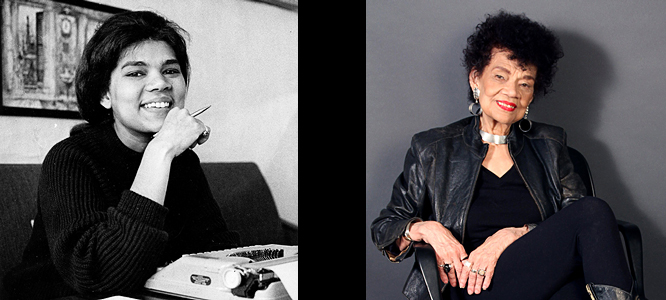
Lorraine O’Grady spent decades thoughtfully positioning her work, her ideas, and the legacy she would leave behind for future generations of artists, collectors, and scholars. Before her passing, she finalized every detail and appointed three trustees to steward the work of her trust: her longtime associate and friend Robert Ransick, her colleague, legacy planning expert, and friend Ursula Davila-Villa, and her cousin and friend Loretta Polk.
During her lifetime, she worked and communicated with her chosen legacy stewards about her ambitions, goals, and desires for her work and legacy to continue to impact present and future generations working across disciplines and regions.
Upon O’Grady’s passing the Lorraine O’Grady Trust came into existence, and following the artist’s directives, the trustees have begun the posthumous legacy work outlined by O’Grady.
Artistic Intention:
O’Grady was a student of Martin Heidegger, and in her last years she would reflect on ideas she had written decades prior about the philosopher’s idea. In particular she was keenly aware that the audience for her art and ideas, while existing in the present, in reality they would truly manifest in the future. The way she envisioned the existence of ideas and art was through Heidegger’s idea of “preservers:”
There’s a wonderful passage in Heidegger where he speaks of the need for “preservers,” that combination of presenters, critics, and audience required for the work to come into existence, into being, after it has been created by the artist… For Heidegger, those who
— Lorraine O’Grady (WIS, p. 47)
The trifecta that Heidegger establishes and O’Grady alludes to will serve as the framework from where the stewardship of her legacy will be carried forward.
O’Grady left a wealth of resources that will serve as the guiding principles to continue and achieve some of the unfinished projects she intended to produce and to identify other opportunities to further expand and connect her extraordinary ideas with future generations.
Mission:
I have many influences, but none that I can follow.
My work has always proceeded out of its own necessities.
— Lorraine O’Grady
The mission of the Lorraine O’Grady Trust is to cultivate and promote the collection and study of the art and ideas of Lorraine O’Grady, and follow in her footsteps in making her lived experience as an artist, woman, and intellectual available to future generations.
Contact:
For all inquiries please email info@lorraineogradytrust.com.
For image licensing, please reach out to Artist Rights Society at: info@arsny.com
Trustee Biographies:
Robert Ransick, Trustee & Executive Director
Ransick first met Lorraine in 1988 at the School of Visual Arts, where he was a photography student and had enrolled in two of her courses: Surrealist Literature and Poetry in Art. At the end of the school year, Lorraine asked him to meet after class to discuss working with her. This was the beginning of a year of intense collaboration on the works that would form her first solo show of wall art, Body is the Ground of My Experience, at Intar Gallery in 1991, curated by Judith Wilson. Lorraine was Ransick’s teacher, mentor, collaborator, and dear friend. Her extraordinary intellect and relentless work ethic never wavered, even during times when she was overlooked.
Lorraine and Robert remained good friends for more than three decades. They also worked on the creation of her first video work, Landscape (Western Hemisphere), and they recorded extensive video conversations about O’Grady’s life in 2010. Lorraine began thinking about the Trust back then and Robert has been engaged in that process throughout.
As an artist, Robert has spent the last thirty years in academia as a professor, leader of various departments and, until recently as Vice President of the Minneapolis College of Art and Design, the institution’s chief academic officer. He also consults the Sherman Fairchild Foundation on their Art & Technology grant program. He holds a BFA in Photography, with honors, from the School of Visual Arts, an MA in Media Studies from the New School for Social Research, and an MBA in Sustainability from Bard College. Robert is married to architect Blake Goble.
Ursula Davila-Villa, Trustee
Davila-Villa first met Lorraine in 2011 as a juror for US Artists, the year Lorraine was awarded a grant. She got to know her in more depth when she joined the team of Alexander Gray Associates in 2012. In 2017, the year Davila-Villa left the gallery, Lorraine hired her to begin working on legacy planning and on placing her digital archive with an institution, which per Lorraine’s wishes became Wellesley College (where her analogue archive is housed and preserved). Davila-Villa is a co-founder of Davila-Villa & Stothart (DVS). DVS focuses on supporting the artistic legacies of artists and families whose work has been historically marginalized or considered unconventional.
She joined the board of ArtTable in 2024, and is a member of the programs committee at Voices in Contemporary Art (VoCA, and advisory board of the Frank Bowling Foundation (London)).
Loretta Polk, Trustee
Polk is Lorraine’s cousin. Her grandmother and Lorraine’s mother were sisters. Loretta’s mother Lucille was like an older sister to Lorraine growing up in Boston, MA. Loretta has over 40 years of legal experience in corporate, international, and public policy work. She is Vice President & Deputy General Counsel of NCTA – The Internet & Television Association, where she has represented the cable industry on a wide variety of legal and regulatory matters, including video and broadband technology, competition, consumer protection, and public safety issues. She leads the association’s privacy and cybersecurity legal and policy work. She has a J.D. from Columbia University Law School and a BA in American Studies from Rutgers University.